Hello everyone,
I’m a student working on a thesis project where I performed shear tests on bonded single-lap joints (SLJ). The tests produced a force–displacement curve, and my task is to reproduce this curve in ANSYS Mechanical using CZM fracture with Contact Debonding.
I expected this to be relatively straightforward, but I’m struggling to obtain a similar response. The simulated joint appears too stiff: the numerical force–displacement curve is much steeper than the experimental one.
What I have tried so far:
I am using fracture-energy-based debonding (CZM contact debonding).
I ran a Taguchi/DOE sweep with 24 combinations of:
maximum normal/tangential contact stress, and
critical fracture energy for normal/tangential separation/slip.
These parameters changed the failure behavior, but did not affect the initial curve(stiffness) of the curve.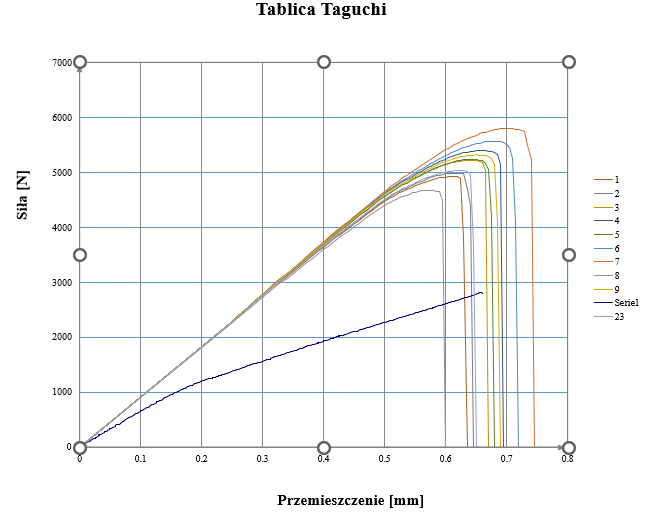
I also tried various contact stiffness adjustments, but these likewise did not significantly change the initial curve.
Has anyone experienced this issue when simulating SLJ shear tests with CZM contact debonding? What settings or modeling choices typically control the initial stiffness in this type of model (e.g., cohesive stiffness/penalty stiffness, bondline thickness, boundary conditions, machine/grip compliance)?